

Pest library · Camponotus spp.
Carpenter Ant Control in Delaware
Carpenter ants hollow out wood already softened by moisture. Finding them indoors means finding the water first, then the nest.
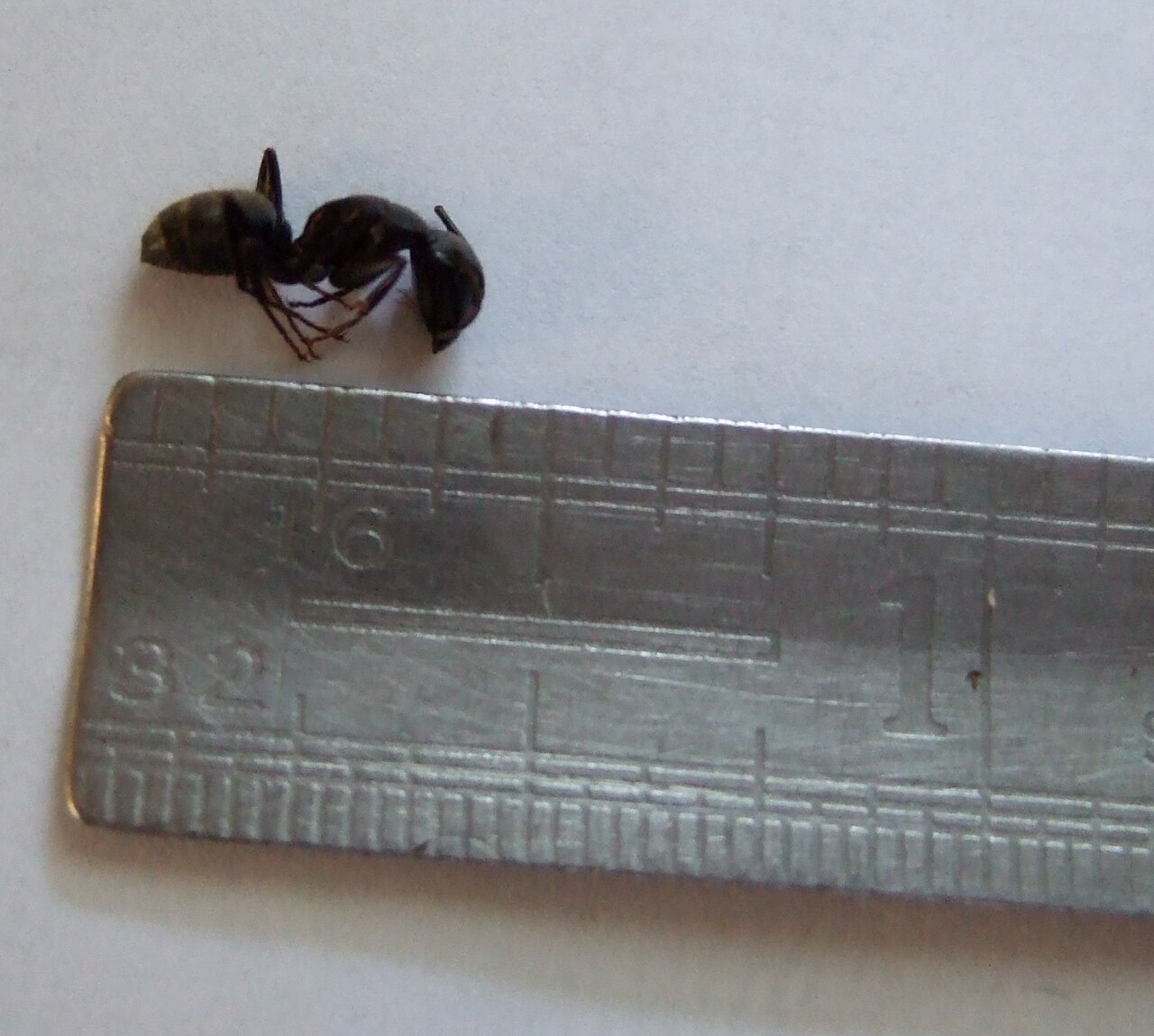
What carpenter ants look like
The common species here is the black carpenter ant, Camponotus pennsylvanicus. Workers run from a quarter inch to over half an inch, making them the largest ants most Delaware homeowners see indoors. They are dull black with fine golden hairs on the abdomen, visible in good light.
Two features confirm it. The waist has a single node, not two. From the side, the top of the thorax forms one smooth even arc with no dips or spines — most other ants show an uneven profile. Colonies are polymorphic, so a mix of large and small black ants on one trail is normal rather than two species.
Swarmers appear in spring, much larger than the workers, with a dark body and smoky brown wings. They are frequently mistaken for termites, which is covered below.
Coarse sawdust-like shavings mixed with insect fragments — frass — under a window sill, door frame or basement beam is the strongest single sign of an active carpenter ant nest.
How they get in
Carpenter ants get in the way any ant does, then stay for a reason other ants do not have. Workers use utility penetrations, gaps around windows and doors, unsealed sill plate seams and, very commonly, limbs touching the roof and siding. They travel long distances, so a parent nest can sit in a stump well out in the yard while workers forage indoors every night.
Why they settle
A satellite nest establishes indoors only where wood is soft enough to excavate easily, and wood gets soft because it stays wet. The locations are predictable: framing under a leaking shower pan, the sill plate above a damp crawlspace, headers behind failed flashing, rim joists near an overflowing gutter, hollow porch columns.
- Roof leaks and damaged flashing, particularly on north-facing slopes
- Poorly drained crawlspaces and trapped moisture under additions
- Bath and kitchen plumbing leaks inside walls
- Gutters discharging against the foundation instead of away from it
- Firewood stacked against the house or stored indoors through winter
- Dead limbs, stumps and landscape timbers close to the structure
Satellite nests hold workers, larvae and pupae but no queen, which is why treating only the indoor nest often fails to stop the traffic. The parent colony outdoors keeps supplying it.
What they do
Carpenter ants do not eat wood. They chew galleries through it to house the colony and push the debris out, which is why frass accumulates below the entry. The galleries are clean and smooth, follow the softer spring growth of the grain, and carry no mud or soil.
Damage is real but slow. A satellite nest in a sill plate or header, left for years, can weaken a member enough to need replacement. That is not the rate of loss caused by eastern subterranean termites, and a colony found in its first season rarely needs structural repair. The greater value of finding them is diagnostic: an indoor nest means water has been getting into the framing, and the water is the more expensive problem.
They do not transmit disease. Large workers can deliver a noticeable pinch, sometimes with formic acid in the wound, but this is defensive and minor. Compared with the small kitchen species on our ants page, they contaminate food far less and matter far more to the building.
When you see them in Delaware
Carpenter ants overwinter as a colony in a chilled, inactive state inside wood. Activity resumes with sustained warmth, usually March into April. Winged swarmers appear from roughly late April through June, and this is when most indoor nests are discovered — dozens of large winged ants at a finished basement or second-floor window means the nest is inside the structure, not in the yard.
Through summer, foraging peaks after dark. Workers run from dusk into the small hours, which is why a homeowner who sees nothing all day finds a steady line across the kitchen floor at eleven at night. Trails follow structural edges: baseboards, toe kicks, joist bottoms, deck ledgers.
Activity falls off through October and stops with hard frost, generally November. Ants indoors in deep winter are significant: outdoor colonies are dormant then, so live workers in January point to a nest inside a heated wall or ceiling cavity.
Older timber-framed housing around Odessa and Dover, and homes near the Delaware Bay marshes east of Smyrna where humidity stays high, see more of them than tight new construction on dry ground.
Carpenter ants vs termite swarmers
In spring both send out winged reproductives, both come out of wood, and both end up dead on a windowsill. Telling them apart decides whether the next call is about ants or about termite control. Collect a few rather than vacuuming them up.
- Antennae — carpenter ant: elbowed, with a long first segment and a bend. Termite: straight, like a tiny string of beads.
- Waist — carpenter ant: sharply pinched. Termite: no waist, sides run straight from head to tail.
- Wings — carpenter ant: front pair clearly longer than the hind pair, staying attached. Termite: four wings of equal length that shed easily, leaving loose piles on sills.
- Color and size — carpenter ant swarmers are large and black with smoky wings. Eastern subterranean termite swarmers are smaller, dark and soft-bodied with milky wings.
- Debris — carpenter ants push out coarse frass with insect parts. Subterranean termites produce no frass, but build mud tubes on foundation walls and piers.
One practical rule: piles of discarded wings with no bodies almost always mean termites. Coarse shavings with no wings almost always mean carpenter ants. If both appear, treat it as two problems until an inspection says otherwise.
How to keep them out
Prevention is mostly moisture management and yard work. Removing food is largely irrelevant, because their main outdoor food is honeydew from aphids on trees and shrubs.
- Repair roof, flashing and plumbing leaks promptly, and replace framing that has gone soft rather than drying it in place.
- Extend downspouts away from the foundation and keep gutters clear.
- Ventilate crawlspaces and maintain a sound vapor barrier, a common need around Camden and Wyoming.
- Trim branches so nothing touches the roof or siding.
- Move firewood off the ground and away from the structure; bring in only what will burn that day.
- Remove stumps, dead limbs and buried construction scrap near the house.
- Seal utility penetrations, caulk window and door trim, and repair damaged sill plates.
None of this eradicates an established colony. It removes the conditions a satellite nest needs, and makes a treated structure less likely to be recolonized from the same yard.
How we treat carpenter ants
The job turns on locating the nest, so inspection is the largest part of the visit. We follow foraging trails, sound suspect framing for the hollow note galleries make, look for frass below sills and beams, check damaged areas with a moisture meter, and inspect the yard for parent colonies in stumps and landscape timbers. Where trails run into a void, we may inspect at night.
Treatment follows what the inspection finds. Located nests in wall voids, framing or hollow columns get a targeted application into the gallery, reaching brood and workers rather than only the ants crossing a floor. Where the nest cannot be reached or the parent colony sits outdoors, we use non-repellent perimeter treatment and baits on active trails, so workers transfer material back through the colony. Repellent products broadcast indoors are avoided — they scatter the ants and hide the trails that make the nest findable.
Because this is integrated pest management, we also document the moisture source. We identify the leak or drainage fault feeding the damaged wood and note it plainly. Treating ants in wood that stays wet buys time, not a resolution.
Monitoring closes it out. Follow-up visits check the treated area, watch for new frass, and confirm trails have stopped rather than shifted. Where outdoor pressure from woodlots or old stumps is heavy, ongoing perimeter service is sensible. To have a suspected nest looked at, use our contact page.
Carpenter Ants FAQs
Do carpenter ants eat wood?
No. They chew galleries through wood to nest in it and push the shavings out as frass, but they do not digest cellulose. That is one of the main differences from termites, which do eat wood.
How do I know if carpenter ants are nesting inside my house?
Look for coarse sawdust-like frass containing insect parts below sills, beams or baseboards, a faint rustling in a wall void, and large winged ants emerging indoors in spring. Live workers indoors in the middle of winter are also a strong indicator, since outdoor colonies are dormant then.
Do carpenter ants bite?
Large workers can pinch with their mandibles and may add formic acid to the wound, which stings briefly. It is defensive behavior and is not medically significant for most people. They do not transmit disease.
Are carpenter ants as damaging as termites?
Generally no. Carpenter ant damage is slower and is limited to wood that is already damp or decaying, while eastern subterranean termites consume sound wood and work through a structure faster. A carpenter ant colony found in its first season rarely causes damage needing repair.
What is the difference between carpenter ant swarmers and termite swarmers?
Carpenter ant swarmers have elbowed antennae, a pinched waist and front wings longer than the hind wings. Termite swarmers have straight antennae, a straight-sided body and four wings of equal length that drop off easily. Piles of shed wings with no bodies usually mean termites.
Why do carpenter ants come back after I kill them?
Indoor nests are often satellites with no queen, supplied by a parent colony in a stump, tree or landscape timber outdoors. Killing the workers you see does not affect the parent colony, so traffic resumes. Effective treatment reaches the nest itself or uses baits that workers carry back.
When do carpenter ants swarm in Delaware?
Swarming usually runs from late April through June, following sustained spring warmth. Winged ants appearing at interior windows point to a nest inside the structure rather than in the yard.
Where we treat
Carpenter Ants control across Delaware
- Claymont, DE
- Hockessin, DE
- Wilmington, DE
- Newark, DE
- New Castle, DE
- Bear, DE
- Delaware City, DE
- Odessa, DE
- Middletown, DE
- Townsend, DE
- Smyrna, DE
- Clayton, DE
- Kenton, DE
- Cheswold, DE
- Hartly, DE
- Little Creek, DE
- Dover, DE
- Wyoming, DE
- Camden, DE
- Marydel, DE
- Magnolia, DE
- Viola, DE
- Frederica, DE
- Felton, DE
- Harrington, DE
- Milford, DE
- Houston, DE
- Lincoln, DE
- Greenwood, DE
- Ellendale, DE
- Bridgeville, DE
- Seaford, DE
- Bethel, DE
- Laurel, DE
- Delmar, DE
Get on the schedule
Dealing with carpenter ants?
Send a photo and a few details. Correct identification is free and it changes the treatment.