
Pest library · Vespidae
Wasp Control in Delaware
Four social wasps account for nearly every nest between Milford and Middletown. The nest tells you which one you have, and that decides how it should be handled.
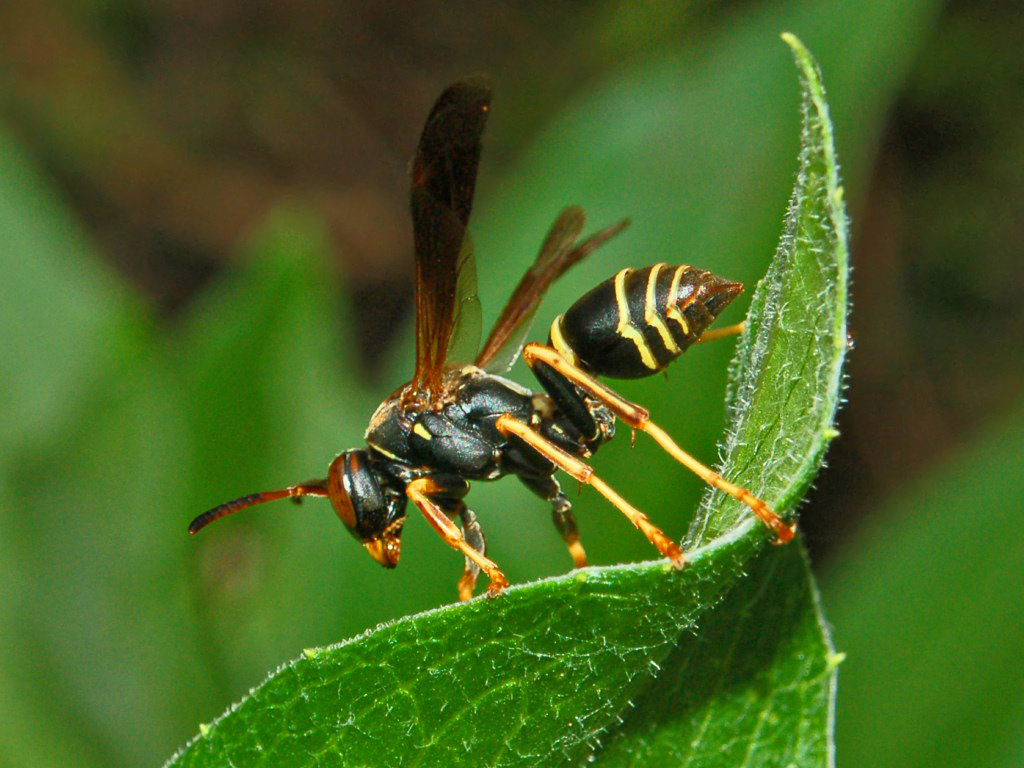
What wasps look like
Four social wasps account for nearly all the nests we deal with between Milford and Middletown. The differences matter: the right approach to a paper wasp under a porch rail is not the right approach to a yellowjacket colony in a wall.
Paper wasps
Polistes species run about three quarters of an inch, slender, with long legs dangling in flight. Color ranges from brown and reddish with yellow markings to the black-and-yellow European paper wasp. The nest is a single open comb on a stalk, no envelope, cells visible from below.
Bald-faced hornets
Dolichovespula maculata is not a true hornet but a large yellowjacket, roughly three quarters of an inch, matte black with ivory-white markings on the face and abdomen tip. The nest is the familiar gray football hanging from a branch or eave.
Yellowjackets
Vespula species are about half an inch, short-waisted, banded bright yellow and black, fast and direct in flight. Nests are enclosed and hidden: in the ground, in wall voids, under sheds. This group causes most stings.
European hornet
Vespa crabro is the largest wasp here at around an inch, brown and yellow with a rusty thorax, and the only true hornet in Delaware. It flies at night and hits lit windows, which alarms people. Nests go in hollow trees, wall voids and attics.
The northern giant hornet, the insect the press called the murder hornet, is not present in Delaware. Confirmed North American detections were limited to the Pacific Northwest, and that population was declared eradicated. A very large wasp here is a European hornet or, more often, a cicada killer: solitary and effectively harmless.
How they get in
Wasps do not want to be in your house. They want a cavity to build in, and a house offers hundreds. Entry is a nest-founding decision made by a single queen in April or May, not a fall invasion. She looks for a dry void with a small defensible opening, builds a starter comb, and the colony grows there through summer.
- Soffit and fascia gaps, especially where the roofline meets a wall return
- Attic gable and ridge vents with damaged screening
- Gaps behind siding, shutters and trim, brick veneer weep holes, and wall voids reached through utility penetrations
- Under decks, porch ceilings, grill covers, playsets and patio umbrellas
- Abandoned rodent burrows, mulch voids and retaining wall gaps, for ground-nesting yellowjackets
Wasps appearing indoors usually mean a nest in the structure. A few showing up in an upstairs room in July with no open window points to a colony in a soffit or wall void that has found an interior gap. Paper wasp queens also overwinter in attics and wander in on warm winter days, which is much less urgent.
What they do
Sting, mostly. Social wasps sting repeatedly because the stinger is not barbed, and they defend a nest hard once it is disturbed within a few yards. For most people a sting is a painful local reaction. For the small number with a systemic allergy it is a medical emergency, which is why a nest near a door, deck or play area is worth handling rather than tolerating.
They are also useful. Wasps are predators, and a paper wasp colony works through a large volume of caterpillars, flies and spiders over a summer. A nest at the far corner of a lot, away from foot traffic, does more good than harm and can be left alone.
European hornets strip bark from lilac, birch and shrub stems for sap and fiber, which can girdle young branches. Yellowjackets shift to sugar in late summer and become the wasps at the trash can and the fruit tree.
Never seal the exterior opening of an active wall-void nest. Blocked wasps do not die quietly. They chew and work inward, and a colony denied its front door often comes through the ceiling or an interior wall instead. Treat first, then seal.
When you see them in Delaware
April to May. The colony cycle runs one year. Mated queens emerge and found nests alone, and the nests are golf-ball sized and easy to remove, which makes this the cheapest month to act.
June to July. The colony builds. Workers take over foraging, numbers climb, and the nest becomes noticeable.
August to early October. Peak size and peak trouble. Yellowjacket colonies can hold thousands of workers, the diet turns to sugar, and defensiveness rises sharply. Almost every sting call falls here.
November onward. Hard frost ends the colony. New queens disperse to overwinter under bark, in leaf litter, in attics and behind shutters. The old nest is never reused, so a gray paper nest hanging in a bare tree in January is empty.
Telling paper wasp, yellowjacket and hornet nests apart
The nest is more informative than the insect, and you can usually read it from a safe distance.
- Paper wasp — a single open comb on a short stalk, umbrella shaped, cells visible from below. Under porch ceilings, deck rails and grill lids. A few dozen wasps, the least defensive of the group.
- Bald-faced hornet — an enclosed gray paper sphere, up to basketball size by September, hanging in the open from a branch or eave with one entrance near the bottom. Hundreds of workers, highly defensive close in.
- Yellowjacket — comb enclosed and hidden, in the ground, a wall void or under a shed. You see steady two-way traffic at a small opening rather than a nest. Thousands of workers by late summer.
- European hornet — enclosed nest in a hollow tree, wall void or attic, often with a brown papery collar at the entrance. Large-bodied wasps, night flight, sightings at lit windows.
Ground traffic at a small hole needs a second look. Steady in-and-out flight at a bare hole in a lawn can be yellowjackets, or it can be solitary ground bees, which are docile, short-lived in spring and generally not worth treating. Yellowjackets are fast, banded, hairless and defensive at the entrance. Ground bees are fuzzy, slower, and ignore you.
How to keep them out
You cannot keep wasps out of a yard, and you should not try. The goal is to stop them nesting where people are.
- Inspect eaves, soffits, deck rails, grill covers and sheds every two weeks from April through June, and remove starter nests early
- Screen attic gable and ridge vents and repair soffit gaps in early spring, before queens are prospecting
- Seal gaps behind shutters, trim and siding while nests are inactive in winter
- Keep trash and recycling lids closed, pick up fallen fruit, cover outdoor food, and drink from cups rather than cans; late-summer yellowjackets work sugar residue hard
- Fill abandoned rodent burrows and voids in retaining walls, and keep mulch beds from developing hollows
Timing beats effort. Fifteen minutes with a flashlight in May removes nests that would need a real intervention in August.
How we treat wasps
Every wasp job starts with locating and identifying the nest. Species determines the approach, because an exposed paper comb, a hanging hornet nest, a ground colony and a wall-void colony are four different problems. Treating a wall void as though it were an exposed nest is how people get stung.
For exposed nests the treatment is direct and the nest is removed once the colony is down. For concealed nests in wall voids, soffits or the ground, we treat at the entrance and into the void so returning foragers carry material through the colony, then allow that traffic time to finish before anything is sealed. Work is timed to activity: early morning and dusk put the greatest share of the colony at home.
Afterward we recheck. A treated colony should show no return traffic within a few days. If it does, the void has a second entrance or a second nest, and we go back. Once a site is confirmed inactive we seal the opening and note the repairs that would stop it recurring: vent screening, soffit gaps, siding gaps. Wasp work sits inside general pest control, with spring nest checks the part worth keeping on the calendar. If there is a nest near a door or a deck, get in touch rather than working on it yourself.
Wasps FAQs
Are murder hornets in Delaware?
No. The northern giant hornet, nicknamed the murder hornet, was only ever confirmed in the Pacific Northwest in North America, and that population was declared eradicated. Delaware's largest wasp is the European hornet, and most oversized wasps reported here are cicada killers, which are solitary and effectively harmless.
What is the difference between a paper wasp and a yellowjacket?
Paper wasps are slender, fly slowly with their legs dangling, and build a single open comb you can see the cells of. Yellowjackets are shorter and stockier, fly fast and direct, and build enclosed nests hidden in the ground or in wall voids. Yellowjackets are far more defensive and cause most stings.
Should I plug the hole where wasps are entering my wall?
No. Sealing an active nest traps the colony inside, and blocked wasps chew inward looking for another exit, which often means into a ceiling or interior wall. The nest has to be treated first and confirmed inactive before the opening is sealed.
Do wasps use the same nest next year?
No. Social wasp colonies die out with hard frost, usually in November in Delaware, and only newly mated queens survive the winter in sheltered spots. The old nest is never reoccupied. A gray paper nest still hanging in a bare tree in midwinter is empty.
Why are wasps so aggressive in August?
Colonies reach their maximum size in late summer, with yellowjacket nests holding thousands of workers. The colony also shifts from hunting protein to seeking sugar, which brings wasps to trash cans, fallen fruit and outdoor food. More wasps plus more contact with people means far more stings.
How do I tell a yellowjacket nest from ground bees?
Watch the traffic. Yellowjackets are hairless, brightly banded, fast, and defensive right at the entrance hole. Ground bees are fuzzy, slower, active mainly in spring, and ignore people entirely, often with many separate small holes across a sunny patch of bare soil.
What is the big brown wasp flying at my window at night?
Almost certainly a European hornet, which is the only large wasp in Delaware that flies after dark and is drawn to lit windows. It is roughly an inch long, brown and yellow with a rusty thorax. It usually means a nest in a hollow tree, wall void or attic nearby.
Where we treat
Wasps control across Delaware
- Claymont, DE
- Hockessin, DE
- Wilmington, DE
- Newark, DE
- New Castle, DE
- Bear, DE
- Delaware City, DE
- Odessa, DE
- Middletown, DE
- Townsend, DE
- Smyrna, DE
- Clayton, DE
- Kenton, DE
- Cheswold, DE
- Hartly, DE
- Little Creek, DE
- Dover, DE
- Wyoming, DE
- Camden, DE
- Marydel, DE
- Magnolia, DE
- Viola, DE
- Frederica, DE
- Felton, DE
- Harrington, DE
- Milford, DE
- Houston, DE
- Lincoln, DE
- Greenwood, DE
- Ellendale, DE
- Bridgeville, DE
- Seaford, DE
- Bethel, DE
- Laurel, DE
- Delmar, DE
Get on the schedule
Dealing with wasps?
Send a photo and a few details. Correct identification is free and it changes the treatment.