

Pest library · Scutigera coleoptrata
Centipede Control in Delaware
The house centipede is a predator that follows dampness and prey. Its presence usually tells you more about the condition of the building than about the centipede.
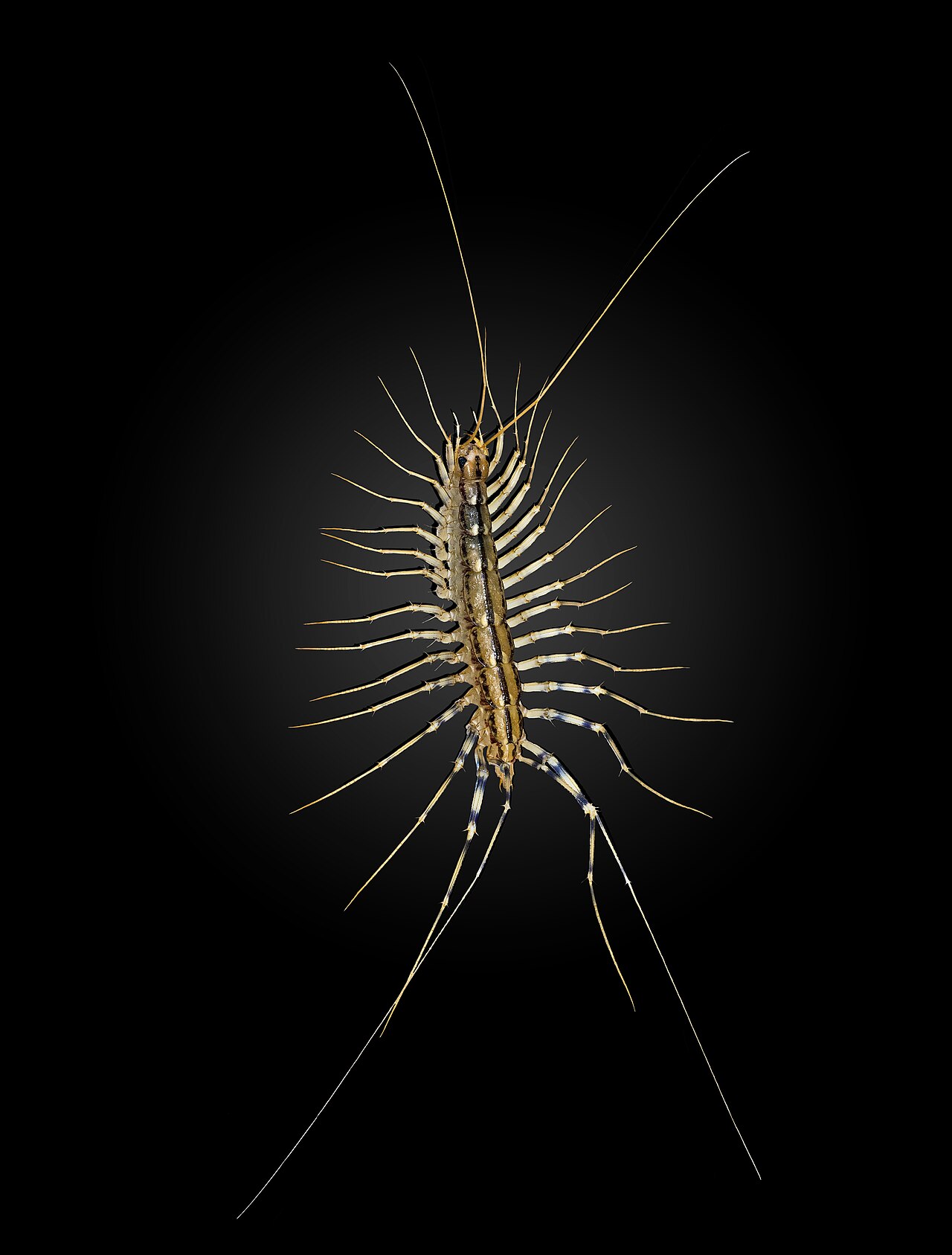
What centipedes look like
The centipede in a Delaware house is almost always the house centipede, Scutigera coleoptrata. The body runs about an inch to an inch and a half long, yellowish-gray with three dark stripes down the back. What people actually register is the legs: fifteen pairs, long and banded, held out wide, with the hind pair trailing behind like a second set of antennae. The leg span is far wider than the body, which is why the animal looks much larger than it is.
They run fast, in a straight line, and then stop dead in the middle of an open floor. They are nocturnal and hunt by touch and vibration through those long legs. Unlike most centipedes they have well-developed compound eyes and are comfortable moving in the open.
Other centipedes occur outdoors here, flatter and darker and slower, living under mulch, logs and stones. They occasionally wander in through a basement door or a slab crack but do not establish indoors. A leggy brown centipede in a garden bed belongs there and is worth leaving alone.
How they get in
Centipedes come in at ground level, and they come in for two reasons: moisture and food.
- Foundation and slab cracks, the gap under a poorly sealed basement door, and unsealed utility penetrations.
- Vented crawlspaces over bare soil, which put damp harborage directly against the structure.
- Window wells that collect leaves and hold water against a basement window.
- Mulch, leaf litter, stacked firewood and landscape timbers piled against the foundation, which is prime outdoor centipede habitat sitting right on the entry point.
- Floor drains, sump pits, and the joint where a basement slab meets the wall.
Once inside they stay where it is damp and where prey is: basements, crawlspaces, utility rooms, under-sink cabinets, bathrooms and the lower reaches of finished basements. At night they travel upstairs and end up in a bathtub or halfway up a bedroom wall, which is where most people meet one for the first time.
What they do
This is the section where we have to be straight with you. House centipedes are predators of other household insects, and on balance they are doing you a favor.
They hunt silverfish, small cockroach nymphs, carpet beetle larvae, spiders, fly larvae and the assorted small insects that live in a damp basement. They do not feed on wood, fabric, paper or stored food. They carry no disease. They build no nests and no webs, chew nothing, and do no damage to a building at all.
They can bite. It is uncommon, generally happens only when one is trapped against skin, and their mouthparts frequently cannot break human skin at all. When a bite does land it is broadly comparable to a bee sting: local pain, some redness and swelling, fading over a few hours. It is not medically serious for most people, though anyone with a known reaction to insect stings should treat it with the same caution.
A house centipede is not damaging your home. It is a symptom. What matters is why the building is damp enough to support both the centipede and whatever it has been eating.
So the honest position is this. The centipede itself is a nuisance and a startle. Finding one occasionally, killing it and moving on is a reasonable response. Finding them regularly is worth investigating, not because the centipedes are dangerous, but because a sustained centipede population means sustained moisture and a prey population you probably have not identified yet.
When you see them in Delaware
House centipedes are active all year indoors, but sightings follow a pattern.
Spring, from March into May, brings the first wave as the ground warms and outdoor populations become active around foundations. Summer is steady in basements and crawlspaces, because Mid-Atlantic humidity keeps those spaces damp and prey numbers high. Late summer heat and dry spells then push outdoor centipedes toward the cooler, moister conditions inside a foundation wall.
The heaviest reports come in fall, ahead of hard frost in November, when outdoor centipedes move toward shelter along with everything else looking to overwinter. It is the same seasonal shift that drives stink bugs onto the sunny side of a house. Winter sightings drop off but never stop, since indoor populations breed and hunt regardless of the calendar.
Centipedes vs millipedes
Both turn up in the same damp places and both get called by each other's names. Telling them apart is straightforward, and it changes what you do about them.
- Legs per segment. Centipedes have one pair per body segment, angled outward. Millipedes have two pairs per segment, tucked underneath.
- Body shape. House centipedes are flattened and leggy. Millipedes are round in cross-section, hard-shelled, and look like a short dark segmented cylinder.
- Speed. Centipedes are fast. Millipedes crawl slowly and coil into a tight spiral when disturbed or dead.
- Diet. Centipedes are predators. Millipedes eat decaying leaves and organic matter and never bite.
- Pattern of entry. Centipedes come in as individuals. Millipedes migrate in numbers, often after heavy rain or in fall, and die in rows along a basement wall or garage floor.
Neither damages a building. Both are moisture indicators, and the same correction, drying out the perimeter and the crawlspace, reduces both.
How to keep them out
Exclusion and drying, in that order.
- Seal the entry points. Foundation cracks, the slab-to-wall joint, gaps around utility penetrations, and a proper sweep on the basement door.
- Pull mulch, leaf litter and firewood back from the foundation and keep a dry band of bare soil or stone against the wall.
- Clear window wells and cover them where they collect water and debris.
- Lay a vapor barrier over crawlspace soil and deal with standing water underneath. Damp crawlspace soil is the most reliable centipede producer in this area.
- Dehumidify basements and lower levels through the humid months.
- Reduce the prey. Taking away the insects a centipede eats removes the reason it stays.
Gutters, downspout extensions and grading matter here as much as caulk. Across the flat farmland and drainage ditches through Kent County, a foundation that stays wet after every rain keeps producing centipedes no matter how carefully it is sealed.
How we treat centipedes
We inspect for moisture and for prey before we treat anything. Where is the damp, and what are the centipedes eating? A crawlspace over bare soil, a leaking hose bib, a bathroom fan discharging into an attic, or a basement running at high humidity all explain a centipede problem better than the centipedes do.
Where treatment is warranted it is an exterior perimeter application into the harborage band against the foundation, plus crack-and-crevice work at entry points, sill plates and slab joints indoors. We do not broadcast product across basement floors. Centipedes do not spend their time in the open, and the application would be wasted. Where the prey population is the real driver we treat for that instead, which is usually general pest control work on the insects supporting them.
Monitors go down in the damp areas to confirm what is present and to track whether numbers are falling. We follow up and adjust, and where the correction needed sits outside pest work, such as a vapor barrier, an exhaust fan, a dehumidifier or drainage, we say so rather than selling repeat treatments against a wet building.
If you are seeing centipedes regularly and want the moisture side looked at as carefully as the insects, get in touch.
Centipedes FAQs
Are house centipedes dangerous?
Not really. They carry no disease, damage nothing in a building, and are predators of other household insects. A bite is possible but uncommon, and it usually feels like a bee sting that fades within a few hours.
Do house centipedes bite?
They can, though it is rare and generally happens only when one is pressed against skin. Their mouthparts often cannot break human skin at all. When a bite does happen, expect brief local pain, redness and swelling rather than anything serious.
Why do I have centipedes in my basement?
Damp conditions and available prey. Centipedes need moisture and follow the insects they eat, so a humid basement or a crawlspace over bare soil supports both at once. Their presence generally points at a moisture problem worth correcting.
What do house centipedes eat?
Other insects and arthropods, including silverfish, small cockroach nymphs, carpet beetle larvae, spiders and fly larvae. They do not feed on wood, paper, fabric or stored food. A steady centipede population means a steady food supply somewhere in the building.
What is the difference between a centipede and a millipede?
Centipedes have one pair of legs per body segment, move fast and hunt other insects. Millipedes have two pairs per segment, are round and hard-shelled, move slowly and eat decaying plant matter. Millipedes also tend to move indoors in numbers after heavy rain.
Should I kill house centipedes?
That is a personal call. They are beneficial predators and harmless to the structure, so many people leave them alone. If you are seeing them often, the more useful response is finding the moisture and the prey rather than dealing with individuals.
When are centipedes most active in Delaware?
Indoors they are active all year. Sightings rise in spring as the ground warms, stay steady through the humid summer, and peak in fall as outdoor centipedes move toward shelter ahead of the first hard frost.
Where we treat
Centipedes control across Delaware
- Claymont, DE
- Hockessin, DE
- Wilmington, DE
- Newark, DE
- New Castle, DE
- Bear, DE
- Delaware City, DE
- Odessa, DE
- Middletown, DE
- Townsend, DE
- Smyrna, DE
- Clayton, DE
- Kenton, DE
- Cheswold, DE
- Hartly, DE
- Little Creek, DE
- Dover, DE
- Wyoming, DE
- Camden, DE
- Marydel, DE
- Magnolia, DE
- Viola, DE
- Frederica, DE
- Felton, DE
- Harrington, DE
- Milford, DE
- Houston, DE
- Lincoln, DE
- Greenwood, DE
- Ellendale, DE
- Bridgeville, DE
- Seaford, DE
- Bethel, DE
- Laurel, DE
- Delmar, DE
Get on the schedule
Dealing with centipedes?
Send a photo and a few details. Correct identification is free and it changes the treatment.