

Pest library · Mus musculus
Mouse Control in Delaware
The house mouse is the rodent most Delaware homeowners actually find indoors. It is small, quiet, breeds through the cold months, and works the edges of a room rather than the open floor.
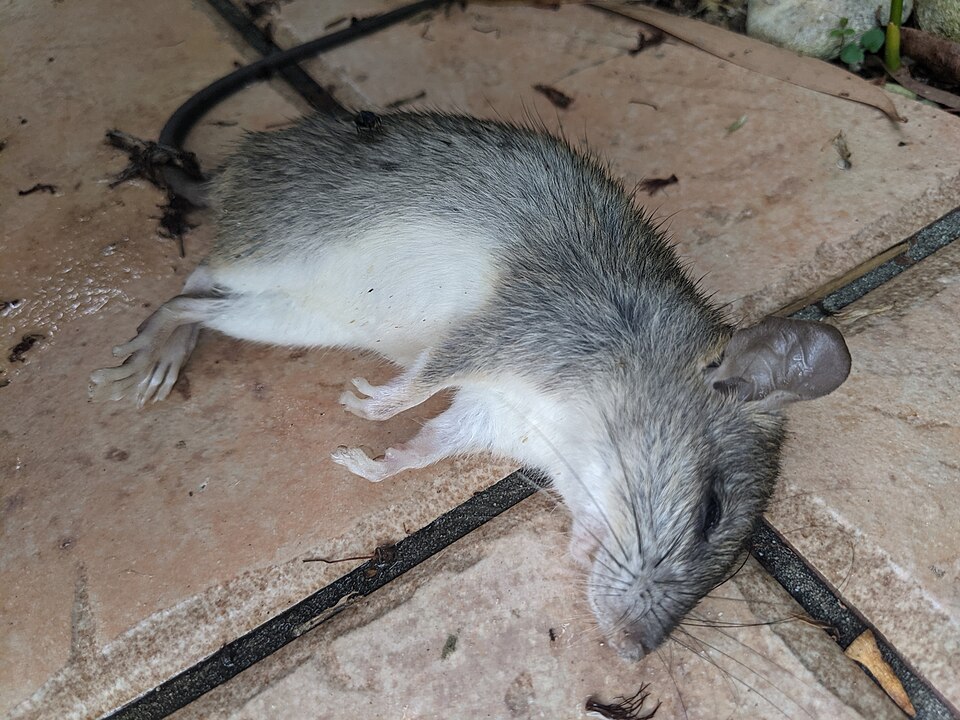
What mice look like
The house mouse (Mus musculus) is small: a body of about 2.5 to 3.5 inches with a thin tail roughly as long again. The coat is dusty gray-brown above, paler below. The muzzle is pointed, the eyes small and black, the ears large and nearly hairless in proportion to the head. An adult weighs well under an ounce.
Few people get a clear look at a live mouse. Identification runs on the evidence, which is specific enough to work from.
- Droppings. An eighth to a quarter inch, dark, tapered at both ends, scattered along travel routes rather than piled.
- Rub marks. Greasy gray smudges where fur meets a hard edge - baseboards, joist faces, cabinet toe kicks.
- Gnaw marks. Small and clean-edged with paired incisor grooves, on cardboard corners, pet food bags and soft sealant.
- Nests. Shredded insulation, paper and fabric packed into a void - a stove insulation blanket, a dishwasher cavity, a stored box.
- Odor. A musky, ammonia-edged smell in closed cabinets and crawlspaces. A late sign, not an early one.
The deer mouse
In barns, sheds and garages backing onto fields through Felton and Harrington, the animal is often a deer mouse (Peromyscus): brown or reddish above, clean white below, with white feet and a bicolored tail. Hantavirus is rare in the Mid-Atlantic, but nesting material should be dampened, bagged and removed rather than swept dry.
How they get in
A house mouse passes through an opening about a quarter inch across, roughly the diameter of a pencil. Where the gap already exists it does not need to chew, and where it does chew, expanding foam, vinyl trim and weathered mortar give way in a night.
- Garage door corners, where the seal has compressed and left a gap at each jamb.
- Utility penetrations - hose bibs, gas lines, air conditioner line sets, dryer vents with failed dampers, unsealed conduit sleeves.
- Weep holes and failed mortar joints in the older brick stock around Odessa and Dover.
- Torn crawlspace vent screen and access doors that no longer seat, common in the crawlspace foundations around Camden and Wyoming.
- The sill plate line on newer slab construction, where housewrap and siding do not close on the slab edge.
What holds them is food, water, warmth and harborage: pet food in a paper bag, birdseed in the garage, stored cardboard, a heated wall void. Mice range only about twenty feet from the nest in a well-supplied building, which is why activity concentrates in one part of a house.
What they do
Mice are a contamination and damage problem rather than a threat. They are not aggressive and rarely bite people. They dribble urine as they travel and leave droppings on the surfaces they cross, so food, dishes and prep surfaces on a runway are compromised.
Gnaw damage is what usually costs money. Rodents chew to control incisor growth, and wiring insulation is a common target - in walls, in attics, and under the hood of a vehicle parked in an infested garage.
Two health points worth stating plainly: mouse allergen is a real asthma trigger where activity has been heavy and sustained, and rodents bring in ectoparasites, so a long-standing population can leave fleas behind after the mice are gone.
One pair is a short-term problem. In a heated building a female house mouse produces litters through the winter, and young reach breeding age in about six weeks. A population left alone from November to March is not the one you started with.
When you see them in Delaware
Mice are present year-round, but indoor calls follow a clear Delaware pattern.
- September to November. The heaviest movement indoors. Harvest through the flat farmland strips cover and food as nights drop, and the first hard frost around November sharpens it.
- December to February. Little new entry, heavy indoor breeding. This is when an autumn problem becomes an obvious one - droppings in new rooms, noise in the ceiling.
- March to April. Warm-up pushes movement back outward into garages, sheds and crawlspaces. Activity looks improved when it has only shifted.
- May to August. Mostly outdoor living and fewer indoor sightings, though garages and outbuildings stay occupied. The best window for exclusion, because pressure is lowest.
Coastal winters along the Delaware Bay are mild enough that outdoor populations are never knocked back, so an untouched exterior gap reproduces the same problem the following year.
Mice vs young rats
This is the identification that changes the plan, and the one most often called wrong. A juvenile Norway rat and an adult house mouse are about the same length.
- Proportion. A young rat has an oversized head, a blunt muzzle and hind feet too big for its body. A mouse is proportionate, with a pointed muzzle and fine feet.
- Ears. Large and thin relative to the head on a mouse; smaller and noticeably thicker on a rat.
- Tail. Thin and uniform on a mouse; thick at the base and coarsely scaled even on a juvenile rat.
- Droppings. The most reliable evidence. Mouse droppings are under a quarter inch and pointed; rat droppings are half an inch or more, capsule shaped and blunt.
- Damage scale. Rats gnaw larger, rougher openings and enlarge them. Mouse gnawing is fine and neat.
Getting it wrong costs a treatment cycle. Rats need larger equipment, different placement, and attention to burrows and drains rather than cabinet voids. If the evidence points that way, read our page on rats first.
How to keep them out
Exclusion is the part of rodent work that lasts. Trapping resolves the animals present; sealing decides whether new ones replace them.
- Seal gaps with chew-resistant material - copper mesh or stainless steel wool packed tight and capped with sealant, sheet metal or hardware cloth on larger openings. Foam and caulk alone are chewed through.
- Replace compressed garage door seals and fit sweeps on service and crawlspace doors.
- Screen foundation and crawlspace vents with quarter-inch hardware cloth, and replace torn screen rather than taping it.
- Move pet food, birdseed and grass seed into metal or rigid plastic containers with fitted lids.
- Swap cardboard storage for lidded totes. Cardboard is both harborage and nesting material.
- Pull mulch and dense plantings back from the foundation, keep trash containers closed, and clear spilled birdseed under feeders.
Sanitation helps but does not solve it. A mouse lives on a few grams of food a day and does fine on crumbs behind an appliance, so a clean kitchen with an open quarter-inch gap still holds mice.
How we treat mice
We work rodents as an integrated pest management problem: inspect, identify, reduce, close the building, verify.
Inspect and identify
The first visit is mostly looking. We work the interior for droppings, rub marks, gnawing and nesting, and the exterior for the actual openings - foundation line, utility penetrations, roofline, garage, crawlspace. Species is confirmed from evidence rather than assumed, since mice, rats and deer mice are handled differently. Moisture and harborage are noted at the same time.
Reduce and monitor
Interior work is trap-based and placed along runways, because mice travel with one side against a vertical surface and rarely cross open floor. Placement density matters more than product choice. Where exterior pressure justifies it, we use tamper-resistant stations outside the structure, sited away from areas used by children and pets.
Exclude and follow up
Sealing is what converts a knockdown into a result, so exclusion is part of the job rather than an add-on, and it is documented with locations. Follow-up is scheduled while monitors stay in place, and we check for new droppings against a cleared baseline rather than on memory. Ongoing coverage runs under rodent control, and mixed problems are usually easier under general pest control. If you are unsure what you have, a photo of the droppings is often enough for us to tell you - get in touch.
Mice FAQs
How small a hole can a mouse get through?
A house mouse can pass through an opening about a quarter inch across, roughly the diameter of a pencil. If the mouse can fit its skull through, the rest of the body follows. Anything larger than that on the foundation line, around a utility penetration or at a garage door corner should be treated as an entry point.
What do mouse droppings look like?
Mouse droppings are about an eighth to a quarter inch long, dark, and tapered at both ends. They are scattered along travel routes rather than left in piles. Rat droppings are much larger, half an inch or more, and blunt at the ends.
Do mice go away on their own in spring?
Sightings often drop in spring because part of the population moves back outdoors, but an established indoor group usually stays. Mice breed year-round in a heated building, so the quiet period is a shift in activity rather than an end to it. Spring and summer are the best time to do exclusion work, before autumn pressure returns.
How many mice is one mouse?
Rarely one. Mice are social, litters are produced through the winter indoors, and young reach breeding age in about six weeks. By the time droppings are showing up in more than one room, you are looking at a group rather than a stray.
Are mice dangerous to people?
They are mostly a contamination and damage problem rather than a direct threat. Mice do not bite people under normal circumstances. The real concerns are food contamination, gnawed wiring, and mouse allergen, which is a genuine asthma trigger in homes with heavy long-term activity.
Is it a mouse or a young rat?
Look at proportion and droppings. A young rat has an oversized head and hind feet that look too large for its body, and a thick, coarsely scaled tail. Mouse droppings are pointed and under a quarter inch; rat droppings are capsule shaped and half an inch or longer.
Why do I only find mice in one part of the house?
Mice have small home ranges and in a well-supplied building may stay within about twenty feet of the nest. Activity concentrates near a food source, a warm void and an entry point. That clustering is useful, because it tells us where to inspect first.
Where we treat
Mice control across Delaware
- Claymont, DE
- Hockessin, DE
- Wilmington, DE
- Newark, DE
- New Castle, DE
- Bear, DE
- Delaware City, DE
- Odessa, DE
- Middletown, DE
- Townsend, DE
- Smyrna, DE
- Clayton, DE
- Kenton, DE
- Cheswold, DE
- Hartly, DE
- Little Creek, DE
- Dover, DE
- Wyoming, DE
- Camden, DE
- Marydel, DE
- Magnolia, DE
- Viola, DE
- Frederica, DE
- Felton, DE
- Harrington, DE
- Milford, DE
- Houston, DE
- Lincoln, DE
- Greenwood, DE
- Ellendale, DE
- Bridgeville, DE
- Seaford, DE
- Bethel, DE
- Laurel, DE
- Delmar, DE
Get on the schedule
Dealing with mice?
Send a photo and a few details. Correct identification is free and it changes the treatment.