
Pest library · Lepidoptera
Moth Control in Delaware Homes
Indoor moths fall into two groups that share almost nothing: pantry moths infesting stored food, and clothes moths feeding on wool and other animal fibers. Identify which before you do anything else.
What indoor moths look like
Almost every moth complaint inside a Delaware home resolves to one of three species, and the differences are visible without magnification.
Pantry moths
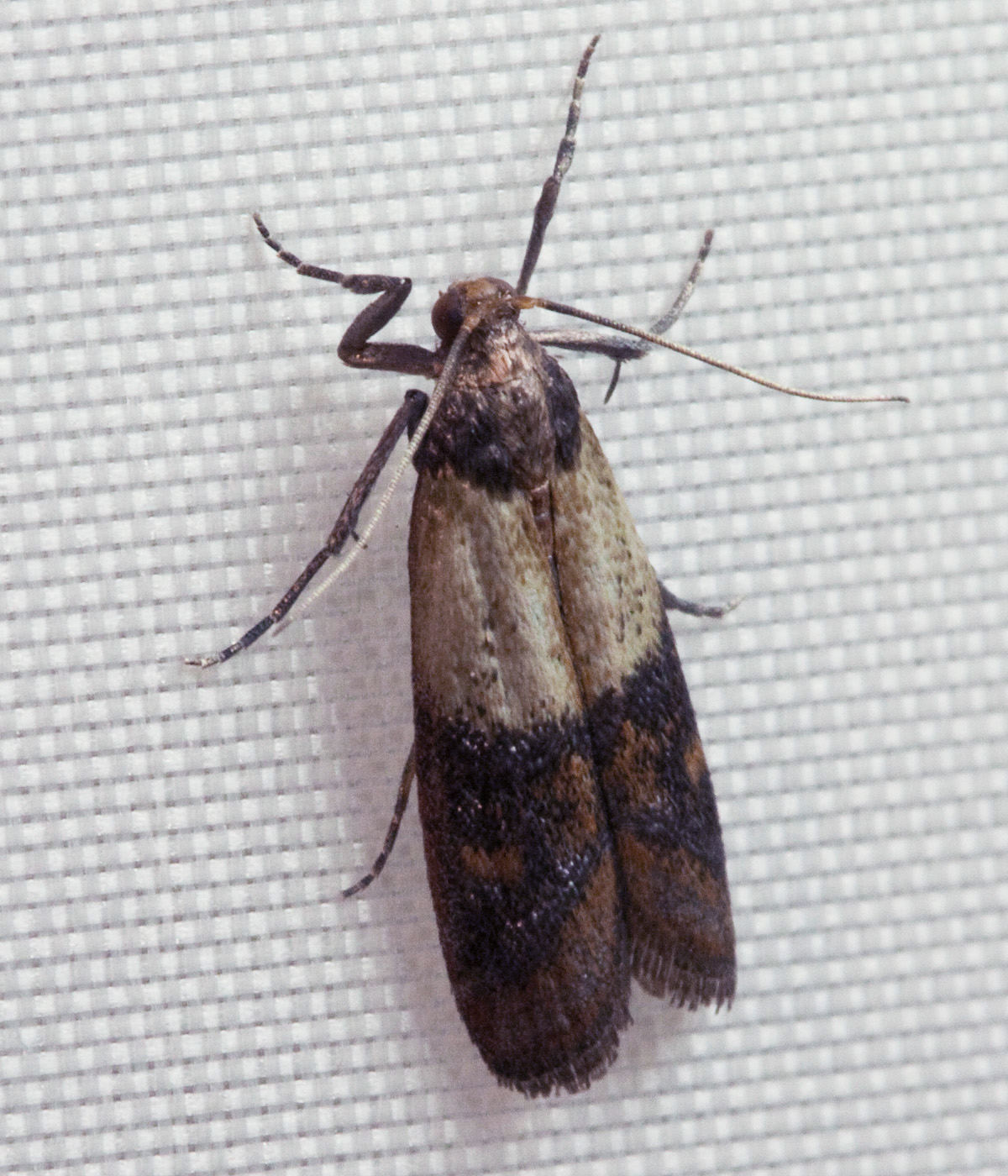
The Indianmeal moth (Plodia interpunctella) accounts for the large majority of pantry infestations. Wingspan is around half to five eighths of an inch, and the forewing is two-toned: inner third pale gray or cream, outer two thirds coppery reddish bronze. That sharp break across the wing is the clearest field mark. The larva is a dull off-white caterpillar up to about half an inch, sometimes tinged pink or green, leaving silk webbing and gritty frass in whatever it feeds on.
Clothes moths
The webbing clothes moth (Tineola bisselliella) is a small, unpatterned buff-gold moth of roughly half an inch wingspan, with a tuft of reddish hairs on the head. It avoids light: rather than flying to a lamp it scuttles, drops, or flies erratically into dark corners.
The casemaking clothes moth (Tinea pellionella) is darker brownish gray with three faint spots on each forewing. Its larva builds a small portable silk case, tinted the color of what it has eaten, and drags it across the fabric.
A moth flying openly across the kitchen toward a light is a pantry moth. A small pale moth that flutters out of a closet and heads for shadow is a clothes moth. Moths at porch lights that slip in the door are outdoor species with no interest in your house.
How they get in
Neither type flies in through a window in numbers. Both arrive inside something you carried home.
Indianmeal moths come in as eggs or larvae already in packaged goods: birdseed, dry pet food, flour, cornmeal, rice, dried fruit, nuts, cereal and chocolate. Bulk-handled grain and seed is a frequent origin, worth knowing where grain farming runs through Felton and Harrington and feed is bought by the sack. One overlooked bag in a garage can supply a kitchen for months.
Clothes moths arrive on the fabric itself: secondhand wool coats, inherited rugs and blankets, felt, taxidermy, feathers, upholstery, and boxes of textiles out of an attic. They also breed where nobody inspects — pet hair under a radiator, lint in floor registers, and abandoned bird or rodent nests, all rich in the keratin the larvae need.
Once established, both spread on their own. Indianmeal larvae wander well away from the food to pupate, often ending where wall meets ceiling. Clothes moth larvae move along baseboards to reach undisturbed material.
What they do
In both groups the adult does no damage. Adult clothes moths cannot feed at all, and adult pantry moths feed little or not at all. Every hole and every ruined package is the work of larvae, which is why killing the moths you can see accomplishes almost nothing.
Pantry moth larvae contaminate rather than destroy. They spin silk webbing through flour, cereal and seed, leaving matted clumps, shed skins and frass, and infested grain develops a stale, slightly sour odor. There is no established disease risk from accidental consumption, but the food is ruined and the packages have to go.
Clothes moth larvae feed on keratin — wool, cashmere, mohair, silk, fur, felt and feathers. Cotton and synthetics are eaten only where blended with animal fiber or heavily soiled. Damage shows as irregular grazed patches and small holes, concentrated where you would expect: collars, cuffs and underarms holding perspiration and body oils, the underside of rugs, and carpet beneath furniture that never moves.
Neither moth bites, stings or carries disease. The cost is economic, and with a good wool coat or rug it is not small.
When you see them in Delaware
Heated houses remove most of the seasonality. Both species complete generations indoors in any month, so a February infestation is not unusual.
Indianmeal moths still track temperature. A generation can close in about a month during a humid Delaware summer and stretch to two or three months in an unheated garage in winter. Activity peaks in late summer and fall, coinciding with new grain, fall birdseed and baking supplies going into the cupboard.
Clothes moth complaints cluster around the two times textiles get handled: spring, when wool goes into storage, and fall, when it comes back out and the damage is found. The feeding happened over the months between, in a dark closet or a bin that was never actually sealed.
Pantry moths vs clothes moths
This is the whole decision. Treating a closet for a pantry infestation, or emptying a cupboard because moths are eating a rug, leaves the source intact.
- Where you see the adults. Pantry moths: kitchen, garage, laundry room, resting high on walls and cabinet faces. Clothes moths: closets, storage rooms, under furniture, along carpet edges.
- Flight behavior. Pantry moths fly openly and are drawn to light. Clothes moths avoid light and move in short, low, erratic flights toward shadow.
- Markings. Pantry moths have a two-tone forewing, pale inner third and coppery outer portion. Clothes moths are plain buff-gold or faintly spotted brownish gray.
- What is damaged. Pantry moths: webbing and clumping in flour, cereal, birdseed, pet food and nuts. Clothes moths: grazed patches in wool, silk, fur and felt.
- Where the larvae are. Pantry moth larvae in and around food packaging, then wandering to ceiling corners to pupate. Clothes moth larvae stay on the material itself.
One honest overlap: silverfish also graze paper and fabric and leave irregular surface damage, but no silk webbing and no cases, and you find the insects themselves rather than caterpillars.
How to keep them out
Source removal and physical storage do the real work. Spraying open cupboards or hanging clothes is no substitute for the steps below.
Pantry
- Move dry goods into airtight glass or hard plastic containers. Cardboard, paper and thin foil are not barriers, and larvae chew through plastic bags.
- Freeze incoming flour, birdseed, cornmeal and nuts for three to four days before they go into storage.
- Rotate stock and date containers. The infestation is usually in the oldest, least-used bag on the top shelf.
- Vacuum shelf lips, cabinet corners and the underside of shelving, where pupae attach.
- Keep bulk birdseed and pet food out of the living space, in sealed bins with tight lids.
Closets and storage
- Launder or dry clean wool and silk before storing. Larvae target soiled areas, so clean fabric is markedly less attractive.
- Store seasonal woolens in sealed containers or garment bags that actually close, not draped in an open closet.
- Vacuum carpet edges, under beds and dressers and inside floor registers, then empty the canister outdoors.
- Know the limits of cedar and mothballs. Cedar oil in an old closet does not kill established larvae, and mothball vapor works only in a sealed container.
- Clear bird and rodent nests out of attics and soffits, since they are a permanent reservoir.
How we treat moths
Inspection first, identification second, and only then any application.
Finding the source
We work outward from where the adults are seen: cupboard by cupboard for pantry moths, including bags nobody has opened in a year, and closets, rugs, upholstery and stored textiles for clothes moths. Species-specific pheromone traps are the diagnostic tool. They attract males of one species, so a trap that catches confirms which moth you have and roughly where the population sits, and repeated counts show whether numbers are falling. Traps monitor an infestation; on their own they do not end one.
Treatment and follow-up
Removing the infested material matters most, and we will tell you which packages or items have to go. After that, targeted crack-and-crevice work on cabinet corners, shelf edges, closet framing and carpet edges under integrated pest management addresses larvae and pupae that left the source. Nothing is applied to food contact surfaces or to garments.
Traps stay in place afterward so the decline can be confirmed. Because larvae wander before pupating, a few adults may appear for weeks after the source is gone; the counts tell us whether that is a tail or a second source. Moth work is usually handled within general pest control service — contact us to have the pantry or closets looked at.
Moths FAQs
How do I tell pantry moths from clothes moths?
Look at where they are and how they fly. Pantry moths appear in the kitchen, fly openly and have a two-tone forewing with a coppery outer portion. Clothes moths appear near closets and rugs, avoid light, and are plain buff-gold or faintly spotted.
Where do pantry moths come from?
They almost always arrive inside packaged food, as eggs or small larvae already present when you bought it. Birdseed, dry pet food, flour, cereal, rice, nuts and dried fruit are the usual sources. One forgotten bag can keep a kitchen infested for months.
Do moths eat clothes, or is it the larvae?
The larvae do all the feeding. Adult clothes moths cannot eat at all. That is why swatting the moths you see does not solve the problem and why the treatment has to find the material the larvae are living in.
Do mothballs actually work?
Only in a sealed container where the vapor can build up to an effective concentration. In an open closet the fumes dissipate, leaving an odor without controlling anything. Cedar has the same limitation and will not kill larvae already in the fabric.
What fabrics do clothes moths damage?
Animal fibers, principally wool, cashmere, mohair, silk, fur, felt and feathers. Cotton and synthetics are attacked mainly where they are blended with animal fiber or soiled with perspiration or food. Damage concentrates on collars, cuffs and undisturbed rug areas.
Do pheromone traps get rid of moths?
No. They catch males of one species, which makes them an excellent diagnostic and monitoring tool, but they do not remove the larvae doing the damage. Use them to confirm the species and track whether numbers are dropping after the source is removed.
Can I still eat food that has pantry moths in it?
There is no established disease risk from accidentally consuming pantry moth larvae, but the food is contaminated with webbing, shed skins and frass and should be discarded. Check every other dry good in the cabinet at the same time, since the infestation is rarely limited to one package.
How long does it take to get rid of moths?
Once the source is found and removed, adult sightings usually taper over several weeks as remaining larvae finish developing. Monitoring traps show whether the count is falling. Sightings that stay level generally mean a second source has been missed.
Where we treat
Moths control across Delaware
- Claymont, DE
- Hockessin, DE
- Wilmington, DE
- Newark, DE
- New Castle, DE
- Bear, DE
- Delaware City, DE
- Odessa, DE
- Middletown, DE
- Townsend, DE
- Smyrna, DE
- Clayton, DE
- Kenton, DE
- Cheswold, DE
- Hartly, DE
- Little Creek, DE
- Dover, DE
- Wyoming, DE
- Camden, DE
- Marydel, DE
- Magnolia, DE
- Viola, DE
- Frederica, DE
- Felton, DE
- Harrington, DE
- Milford, DE
- Houston, DE
- Lincoln, DE
- Greenwood, DE
- Ellendale, DE
- Bridgeville, DE
- Seaford, DE
- Bethel, DE
- Laurel, DE
- Delmar, DE
Get on the schedule
Dealing with moths?
Send a photo and a few details. Correct identification is free and it changes the treatment.