

Pest library · Ixodida
Tick Control in Delaware
Three tick species are common in Delaware. Only the blacklegged tick transmits Lyme disease here, and its nymphs are out in early summer when they are hardest to see.
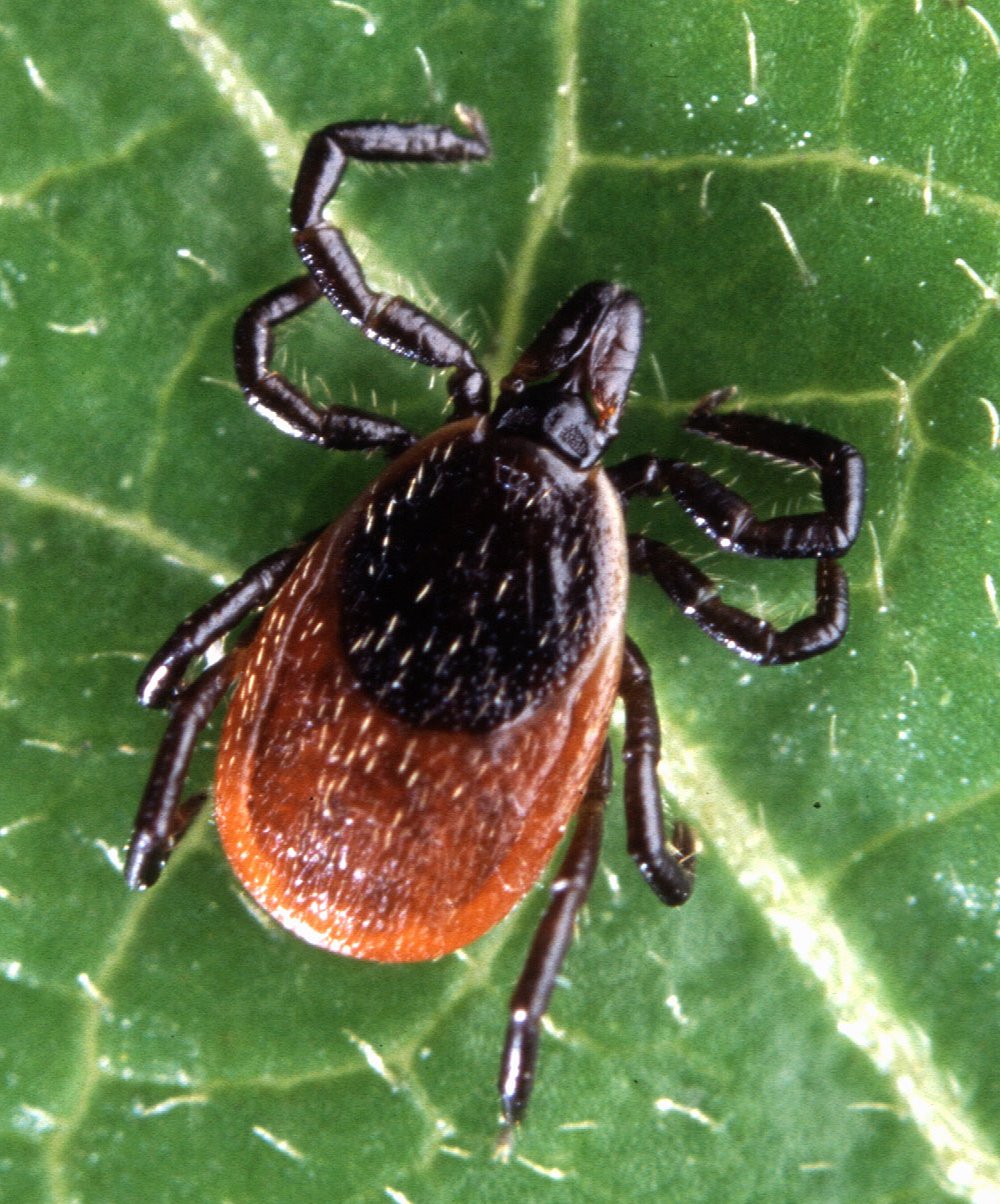
What ticks look like
Ticks are arachnids, not insects. Adults and nymphs have eight legs, no antennae and no wings; larvae hatch with six. The body is flat and teardrop-shaped when unfed and swells to a gray or olive bean shape when engorged, which is why a fed tick often looks like nothing recognizable.
Size is the detail people get wrong. An unfed adult female is about the size of a sesame seed. A nymph is the size of a poppy seed and reads as a speck of dirt. Most Lyme disease here is attributed to nymphs for that reason: they are small enough to go unnoticed for days.
The three species you will find here
- Blacklegged or deer tick (Ixodes scapularis) - small, with a dark reddish-orange abdomen, a solid black shield behind the head on adult females, and uniformly dark legs.
- Lone star tick (Amblyomma americanum) - rounder, with longer mouthparts, and the adult female carries a single distinct white dot in the center of her back.
- American dog tick (Dermacentor variabilis) - the largest of the three, brown with a heavily mottled cream or gray pattern on the shield, and short mouthparts.
How they get in
Ticks do not jump, fly or drop out of trees. They quest: climb a grass stem or leaf edge, hold on with the rear legs and extend the front pair, waiting for something to brush past. Whatever brushes past picks them up. That is the whole mechanism, and it explains where encounters happen.
Questing requires humidity. A tick that dries out dies, so they concentrate where the ground stays damp and shaded: leaf litter along a wood line, the transition where lawn meets brush, tall grass, groundcover such as ivy, wood piles that shelter small mammals, and shaded ditch banks through the farmland. Open, sunny, mown turf is poor tick habitat.
- Walking or working along a brushy property edge, a hedgerow, or the border of a farm field or ditch.
- Dogs and outdoor cats, which quest-height vegetation catches easily and which carry ticks indoors.
- Deer and small mammals moving through a yard; mice and chipmunks are the main hosts for immature blacklegged ticks and the reservoir for the Lyme bacterium.
- Firewood, leaf piles and yard debris brought in from the wood line.
Indoors, ticks are poor survivors. They need high humidity and a host, and a blacklegged tick on carpet usually dries out. Homes do not develop tick infestations the way they develop flea problems.
What they do
Ticks feed slowly. A blacklegged tick inserts barbed mouthparts, cements itself in place and feeds for days, which is why an attached tick is not something you brush off.
The health question is worth stating precisely. Lyme disease is transmitted in Delaware by the blacklegged tick and by no other species here. The bacterium lives in the tick's gut, and transmission generally requires the tick to be attached and feeding for a day or more, which means prompt removal is genuinely effective rather than a formality. Not every blacklegged tick is infected, and a brief attachment carries low risk. Anaplasmosis and babesiosis are also carried by this species and are less common.
Lone star ticks are aggressive and will move toward a host across a short distance, which the other two do not do. They do not transmit Lyme disease. They are associated with ehrlichiosis, a Lyme-like rash illness, and alpha-gal syndrome, a delayed allergic reaction to red meat that develops in some people after a bite. American dog ticks can transmit Rocky Mountain spotted fever, uncommon here but serious.
Remove an attached tick with fine-tipped tweezers: grasp as close to the skin as possible and pull straight out with steady pressure. Do not twist it, burn it or coat it in petroleum jelly. Clean the bite, note the date, and watch for a spreading rash or fever.
When you see them in Delaware
Ticks run a longer season here than most people expect, and the highest-risk months are not the ones you would guess.
Blacklegged tick nymphs are active from roughly May into July. That is the peak human risk window in the Mid-Atlantic: nymphs are poppy-seed sized, abundant, and out at exactly the time people are gardening, mowing edges and walking in shorts. Adults of the same species are active in fall, stay active through mild winter spells, and return in early spring. A January thaw above freezing puts adults back on the vegetation.
Lone star ticks run spring through late summer, with adults and nymphs overlapping through the humid months. American dog ticks peak in late spring and early summer along trail edges and in tall grass. There is no month in Delaware with zero tick activity, and mild coastal winters near the bay keep adult blacklegged ticks in play.
Blacklegged vs lone star vs dog tick
Identification changes what you do next, so it is worth the thirty seconds. Photograph the tick on a light background before disposing of it, and check leg color, markings and mouthpart length.
- Blacklegged (deer) tick - small, no pale markings, dark legs, black shield over a reddish-orange body on adult females. The Lyme vector. Nymphs are tiny and uniformly dark.
- Lone star tick - medium to large, single white dot on the female's back, long mouthparts, and the only one of the three that will walk toward you.
- American dog tick - largest, with obvious cream marbling across the shield and short mouthparts. Common on dogs and along trail edges.
Two further points save unnecessary worry. A fully engorged tick of any species is gray, swollen and largely stripped of its pattern, so judge by size, leg color and mouthpart length rather than markings. And a tick found crawling, with no bite site and no attachment, has not transmitted anything.
How to keep them out
Yard work does most of the useful work here, because tick pressure sits in a narrow band of habitat rather than spreading evenly across a property.
- Keep grass cut and clear leaf litter, particularly along the wood line and fence rows.
- Create a three-foot mulch, gravel or bare strip between lawn and woods; ticks rarely cross dry open ground.
- Move play equipment, patios and seating away from the yard edge and into open sun.
- Thin dense groundcover near the house, and stack wood off the ground and in sun so it shelters fewer rodents.
- Discourage rodent harborage, since mice and chipmunks feed immature ticks; the exclusion work that helps with mice helps here too.
Personal habits close the remaining gap. Tuck pants into socks on brushy ground, wear light colors so ticks are visible, use an appropriate repellent, and do a full body check the same day, including behind the knees, waistband, hairline and armpits. A shower within a couple of hours removes unattached ticks, and a hot dryer cycle kills what is on your clothes. Keep pets on a veterinarian-recommended preventive.
How we treat ticks
We inspect and map the property first. Tick pressure is almost never uniform, so we identify the habitat bands - wood line, hedgerow, ditch bank, ivy beds, the shaded strip along a fence - and note where they intersect the areas people and pets actually use.
Identification follows, because the species present changes the timing. A program aimed at blacklegged ticks is weighted toward the nymph window in late spring and the adult window in fall. A lone star population needs coverage through the humid midsummer months instead.
Treatment is a targeted application to the habitat band and the transition edge, not a broadcast over open lawn where ticks are not questing anyway. Applications are timed to the active life stages and repeated on a seasonal cycle. Where rodent hosts drive the population, addressing harborage is part of the plan, because treating vegetation while the mouse population sits untouched gives short-lived results.
Then we monitor: sampling or visual checks in the treated bands, and adjusting the schedule if activity persists. Nothing removes ticks from a wooded lot, and we will not tell you otherwise. The aim is to cut encounter rates where you actually spend time. Our tick control page covers the seasonal program, and because the same humid edges produce mosquitoes, the two are usually run together. To have a property assessed, get in touch.
Ticks FAQs
Which ticks in Delaware carry Lyme disease?
Only the blacklegged tick, Ixodes scapularis, also called the deer tick. Lone star ticks and American dog ticks are common in Delaware but do not transmit Lyme disease. Blacklegged ticks can also carry anaplasmosis and babesiosis, which are less common.
How long does a tick have to be attached to transmit Lyme disease?
Transmission generally requires the tick to be attached and feeding for a day or more, because the bacterium has to move out of the tick's gut. That is why a same-day body check and prompt removal reduce risk substantially. A tick found crawling and unattached has not transmitted anything.
What is the right way to remove a tick?
Use fine-tipped tweezers, grasp the tick as close to the skin as possible, and pull straight out with steady pressure. Do not twist, burn it, or smother it in petroleum jelly. Clean the bite afterward, note the date, and watch for a spreading rash or unexplained fever.
When are ticks most active in Delaware?
Blacklegged tick nymphs peak from roughly May into July, which is the highest-risk period because they are poppy-seed sized and easy to miss. Adults of the same species are active in fall, through mild winter spells and again in early spring. Lone star and American dog ticks are mainly spring through late summer.
Can ticks infest my house?
The ticks found in Delaware yards do not establish indoors, because they need high humidity and a host and dry out on carpet. Ticks carried in on people or pets are individual hitchhikers rather than an infestation. The brown dog tick is the one exception, and it is mainly a kennel problem.
What does a lone star tick look like?
The adult female has a single clear white or cream dot in the middle of her back, a rounded body and noticeably long mouthparts. Males have faint pale streaking near the rear edge instead of a dot. Lone star ticks are also the most aggressive of the three and will move toward a host.
Do ticks die off in winter in Delaware?
No. Adult blacklegged ticks stay active through fall and become active again on any winter day above freezing, and mild coastal winters near the Delaware Bay keep them going. Cold weather reduces activity but does not end it, so checks after winter yard work or hunting are still worthwhile.
Where we treat
Ticks control across Delaware
- Claymont, DE
- Hockessin, DE
- Wilmington, DE
- Newark, DE
- New Castle, DE
- Bear, DE
- Delaware City, DE
- Odessa, DE
- Middletown, DE
- Townsend, DE
- Smyrna, DE
- Clayton, DE
- Kenton, DE
- Cheswold, DE
- Hartly, DE
- Little Creek, DE
- Dover, DE
- Wyoming, DE
- Camden, DE
- Marydel, DE
- Magnolia, DE
- Viola, DE
- Frederica, DE
- Felton, DE
- Harrington, DE
- Milford, DE
- Houston, DE
- Lincoln, DE
- Greenwood, DE
- Ellendale, DE
- Bridgeville, DE
- Seaford, DE
- Bethel, DE
- Laurel, DE
- Delmar, DE
Get on the schedule
Dealing with ticks?
Send a photo and a few details. Correct identification is free and it changes the treatment.